We are currently facing quite warm, sunny weather in western Europe. This causes quite some headackes for a lot of growers. Lots of berries to pick, but how to keep the quality good and the and the crop fresh, active.
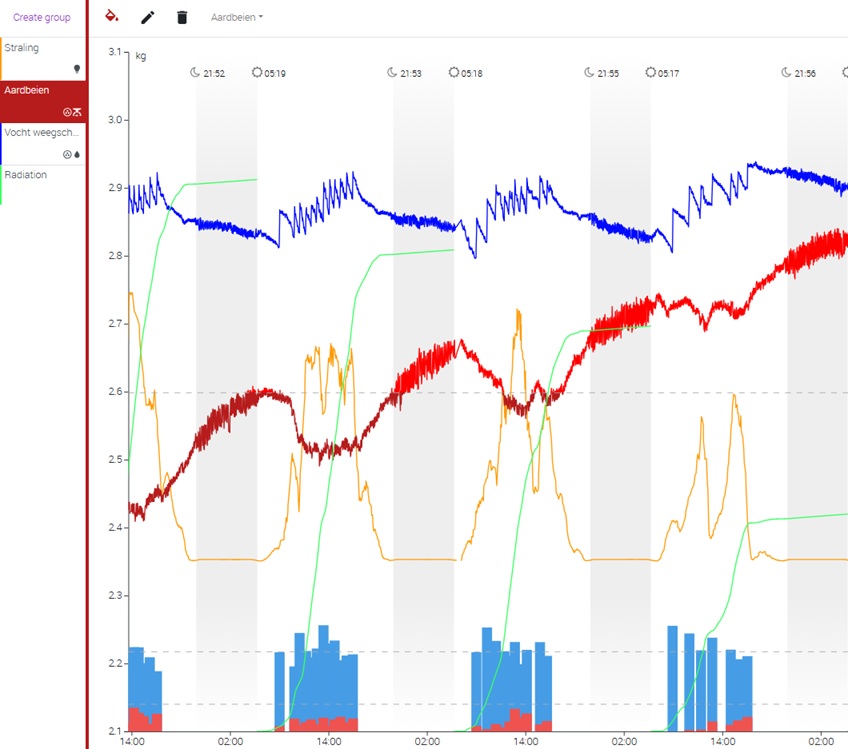
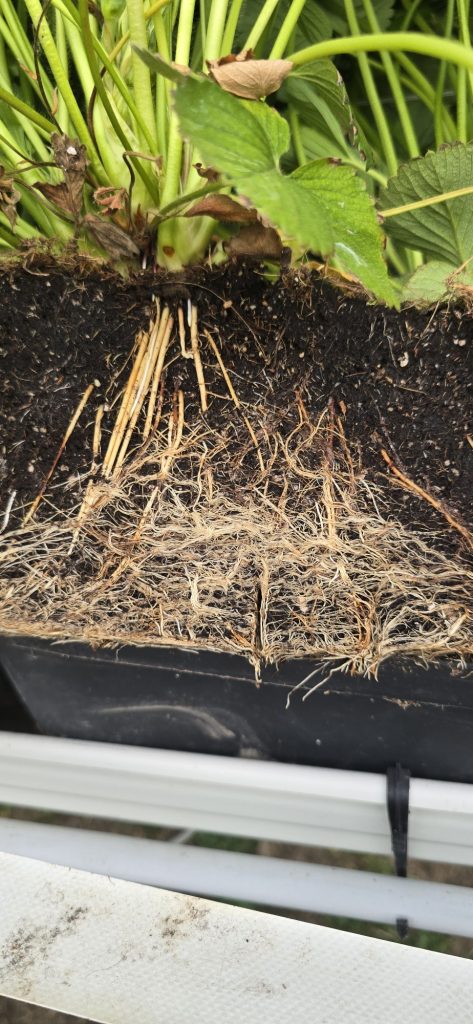
With the sunny weather we see the drain EC’s climbing, crops ageing, berries getting smaller and shelf life going down. Yes temperatures are high, but is it all because of the temperatures? Increasing EC’s show another direction also: not enough water. Looking at the roots, this connects: also the roots show there is not enough water for a lot of strawberries. Yes the numbers are right: average drain percentages 30-40%. As my professor mentioned: no bigger lie as an average. This is supported by weighing gutters: in the morning and afternoon enough moisture content, at the heat of the day, moisture contents drop, so does the drain percentage.
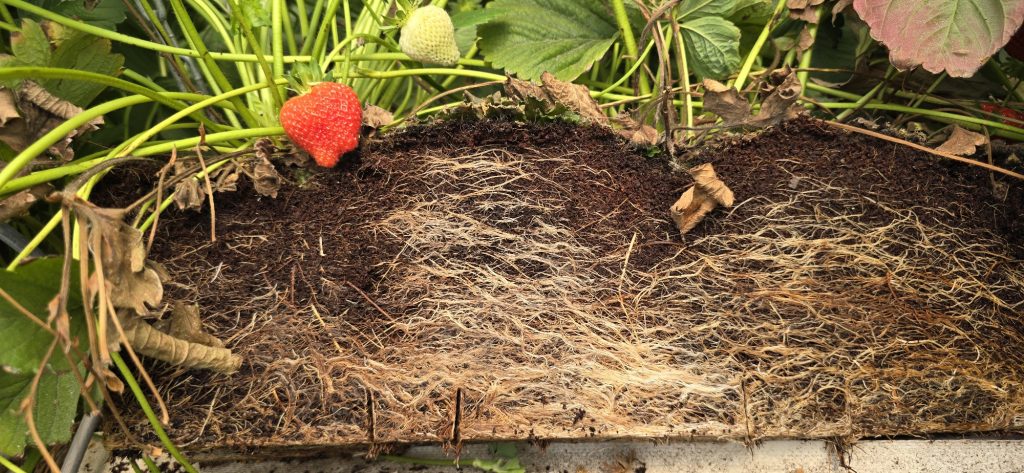
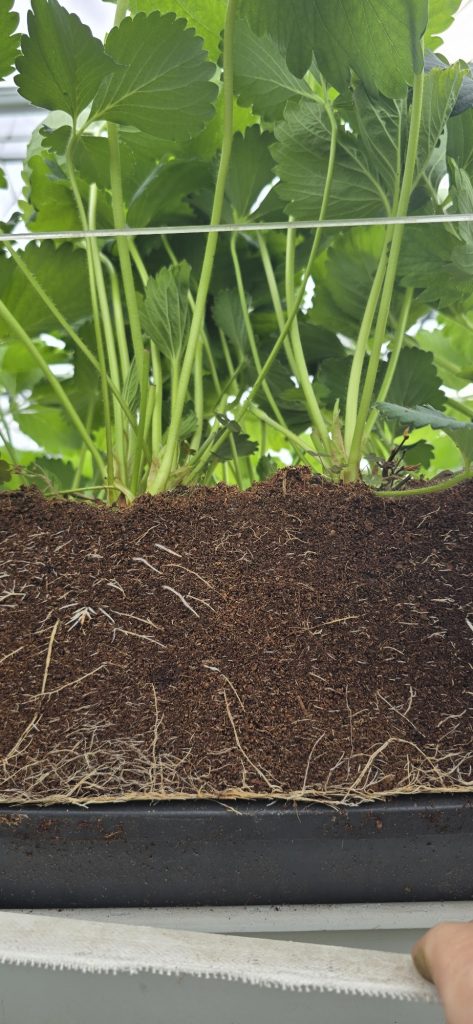
Below a picture of the roots of such strawberries: around the dripper: a nice amount of white roots. Between the drippers only at the bottom of the buckets. And if we measure the EC: between the drippers high – going up to 3, just below the drippers: normal 1,5-1,8.
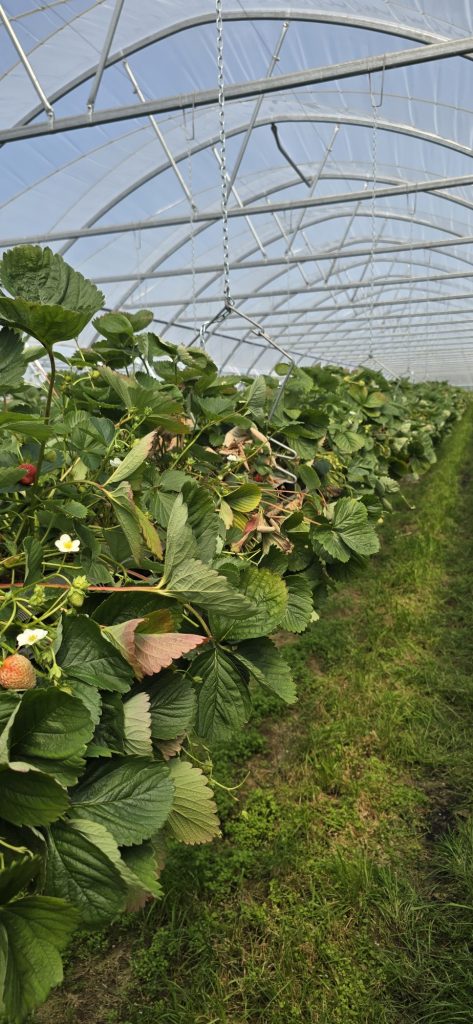
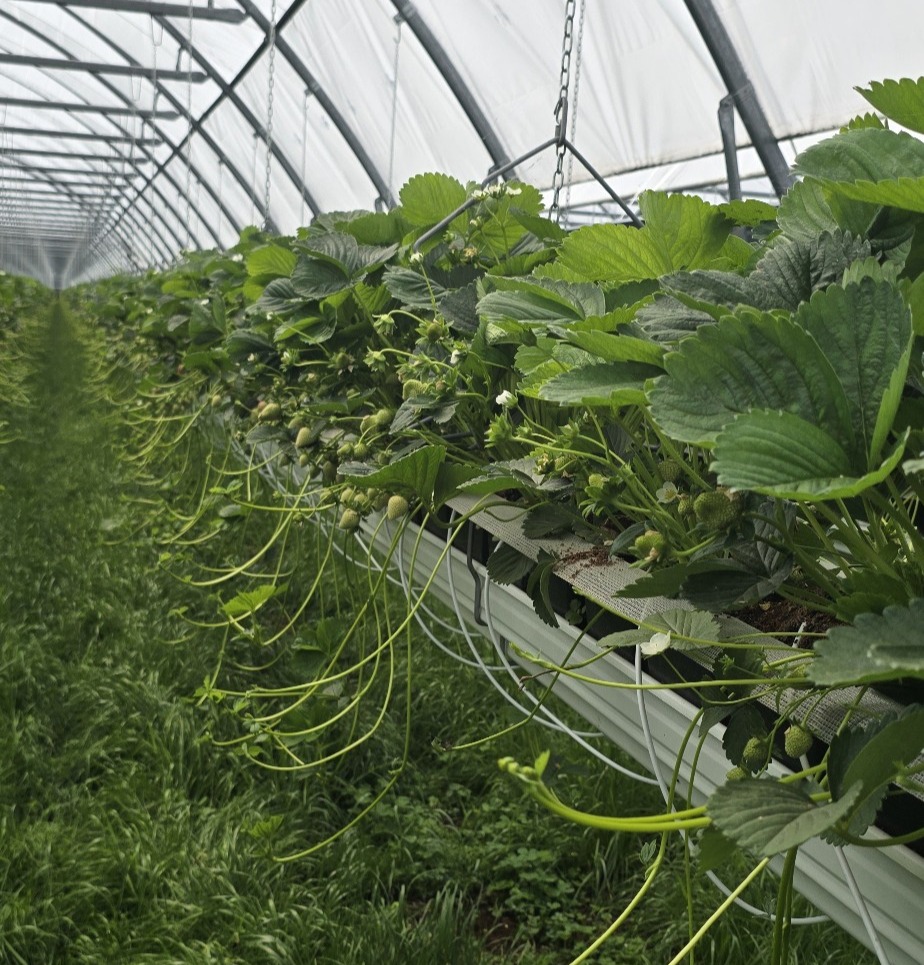
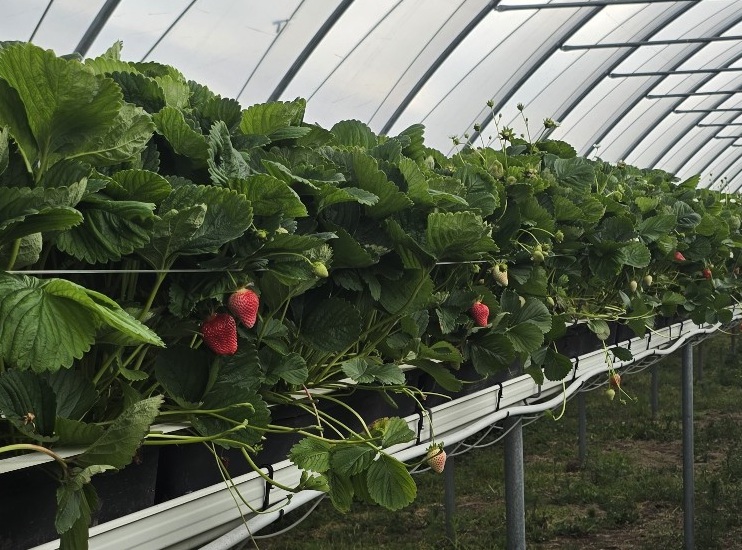
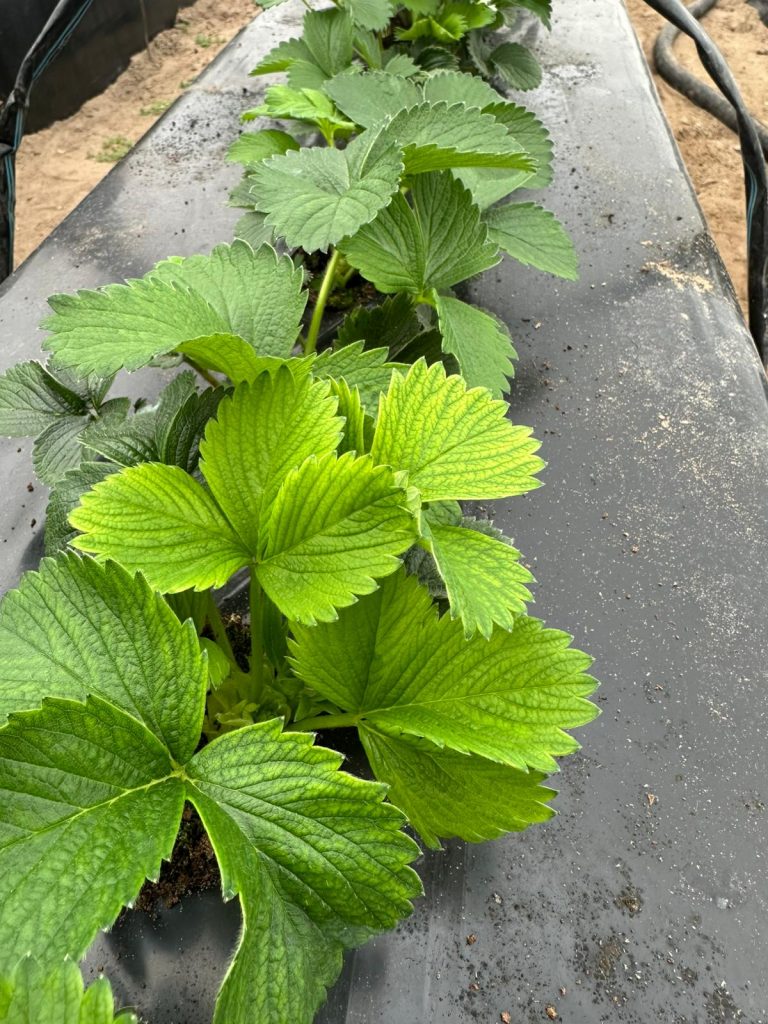
The crop below shows it also: they can’t handle the lower moisture content in the heat of the day, just as it is needed the most. This causes ageing of the leafs.
Problem
The relation between radsum and evaporation is not lineair. In the lower radiation the evaporation is relative lower and in the higher radiation – the heat of the day – the evaporation is relative higher.
Solution
Most irrigationcomputers can set influences on the shot size. A setting can be: from 500-1000 Watt add + 20-% on your shot size.
In that case the morning and the late afternoons still have the normal shot size. But in the heat of the day in stead of for example 400 ml/shot/linear meter a shot of 480 ml/linear meter is given.
This helps the plant in the water uptake. And we see EC’s don’t increase so much in the hot summer period. Plants stay fresh and active, fruit quality improves.
For quite some growers in that do a summer planting for Long Day varieties, the new planting season has started.
Our experience in the last day is that planting depth can be quite important. Especially if a variety is sensitive to crown diseases, the difference between good planting, just good, or too deep is quite a lot.
Last year i have seen strawberrie plantings in greenhouses with till about 20% of the plants dying because they where planted to deep and another 20-30% of the plants not growing fine because of incorrect planting.
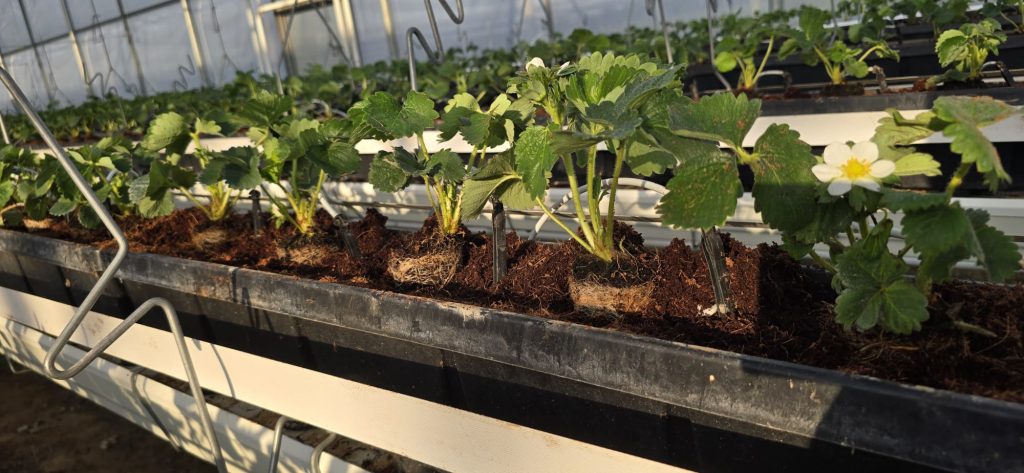
Standard rule is: the top of the tray should be about 2 cm above the substrate level. In that case the head of the plant dries up way bether, causing healthier plants (less crownrot for example).
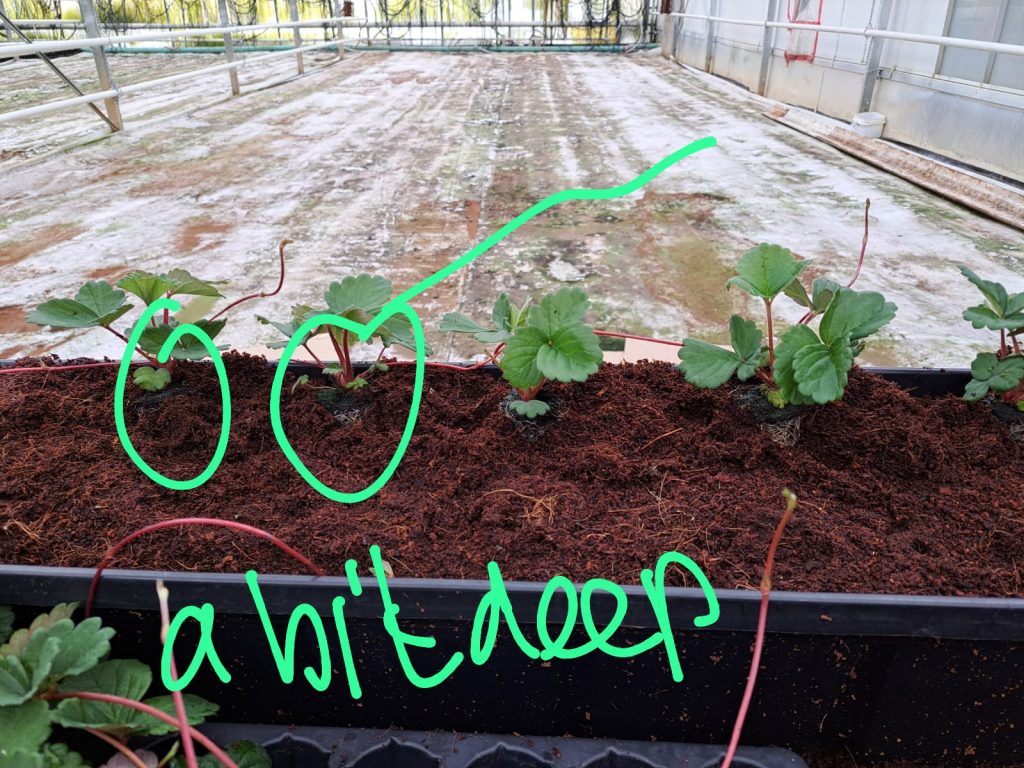
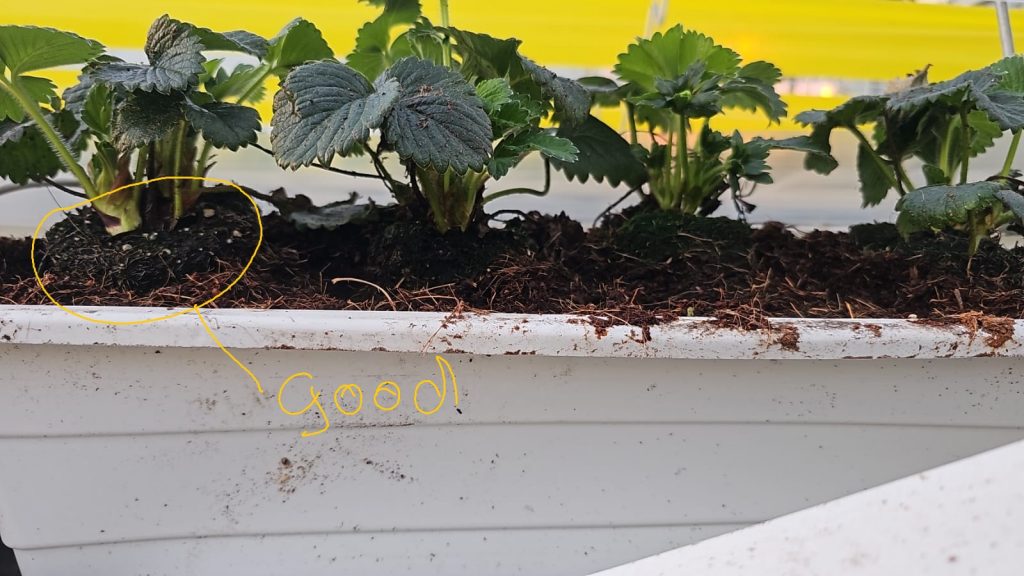
Below a picture – this seems to deep but is very good planting work.
On the picture the plants seem a bit high, is between 2-3 cm ü very good. With correct irrigation this gives the perfect start fo the plants: 7 days after planting the first roots are allready around 12-15 cm long. That is way longer as the standard 1 cm/day growth would give.
This spring we had allready several discussions about type of plants. Are varieties long day or short day or day-neutral or everbearers?
Especially with everbearers / Day-Neutral this had allready quit big consequenses.
An example: a grower has a greenhouse and outdoor table tops in tunnels, about 10 ha. Normally he plants them around the end of march / beginning of april. But early strawberries are expensive, so why not planting the plants first in a greenhouse, let them grow for a month or so and then as a better developed plant, plant them outside.
About 6 weeks after planting the plants in the tunnels, he calls: “i see a lot of runners and only a few flowers, what is going on here. They are everbearers, so i should have flowers in stead of runners”.
If it where everbearers – accordig the word: they ever initiate flowers – then he was right. But do everbearers always initiate flowers, or under every sircumstances?
My experience is totally different: so far i have only seen short day strawberries and long day strawberries. Everbearers and Day-neutral are for what i have seen long day strawberries. : – Long day strawberry is a variety that produces fruits when the days are longer then a certain number of hours (differs per variety) – Short day strawberry is a variety that produces fruits when the days are shorter then a certain number of hours (differs per variety). – Everbearer or Day-Neutral are varieties, that produce fruits independend of the lenght of the day: 6 hours daylenght or 20 daylenght or different, they just produce fruit. To be honest: i have never seen such varieties.
Conclusion for me: We only have Long day varieties or short day varieties – no real day neutral or everbearers.
There is one but: The flowering of varieties does not only depend on daylenght. Factors like vegetative growing and generative growing influence the flowering a lot.
Example: Elsanta is a short day variety. The critical daylenght of Elsanta is about 13,5 hours, that means as soon as the daylenght gets shorter, it will start with flowerinduction. If you give them stress (dry out, no nitrogen, very high temperatures, etc) flowerinduction may start allready at 14-14,5 hours. On the other hand if you pamper them very much (very nice irrigation, high nitrogen and ammonium, nice moderate temperatures, flowerinduction may start only just at daylenght of 13 hours or shorter.
I have the feeling that that daylenght can be that short in some countries and circumstances that generative, that some varieties always induce flowers, but are in fact long day varieties, or short day varieties, because if we grow these in other climates with other day lenghts, they sometimes do initiate flowers, sometimes they don’t.
Quite some grower of strawberries used to pick leaf’s for several reasons. It doesn’t always make sense to me.
The principle of strawberry growing is: use sunlight and try to grow the best strawberries with that sunlight. No sunlight means no strawberries. And also for strawberries the 1% rule applies: 1% lower radiation = 1% lower yield
With deleafing the radiation does not change, but the uptake or use of sunlight does.
We used to measure the LAI of strawberries. In a lot of cases the LAI remains below 2,5 sometimes even way below 2. The optimum LAI for strawberries is >2,8 in order to catch as much sunlight as possible.
De leafing incase of a lower LAI means: not enough energy, means: not enough leafs and or berries, means: lower yields, worser taste and fruit size.
Can we pick leafs? Yes but:
Only if leaf area is enough (>3,2)
Only if it makes sense (disturbs other points of growing like for example fruit quality, disease control etc)
Picking leafs from the heart of the plant in order to stimulate flowering doesn’t make sense in strawberries. A strawberry is not a tomato and doesn’t react like a tomato. If you like to have more strawberries: first take care of your leaf area, second: grow balanced: not too generative, not too vegetative.
Good Leaf Area – trusses are coming!
My big struggle with a lot of strawberries is: the LAI is too low, thus loosing 10-30% or more yield. In that case, the numbers of berries can be there, but the fruits just stay smaller = low picking rates and a low yield.
Good irrigation is a struggle. In our praxis as consultant we seldom see the irrigation just done good. We see the following main issues:
From late starts to early stops – causing a big drydown overnight
Early starts to late stops – causing too wet substrate overnight
High joules between the irrigations – causing dry substrate
Set minimum times between the irrigations to big, causing dry substrates on sunny days
Set maximum times between the irrigations to low, causing too wet substrates on dark cloudy days
Sub optimal irrigation causes a lot of problems. From bad quality fruits (soft, sensitive skin) to low yields, bad shelf life. It is one of the main issues if we talk about fruit quality.
So far we assumed that there is a linear relation between radiation (Watt) and evaporation. Thus irrigation on joules is one of the most reliable ways of irrigation. Still I think it is one of the better ways of setting up your irrigation. But in hot summers, or circumstances with a lot of sun, we always see dry substrates, increasing EC etc.
A small modification of your settings may help. Adding an influence of radiation on shotsize: for example in the range 500-1000 Watt: add 10-20% on your shotsize. This will increase the shots in the hot of the day, but decrease it again at the beginning and ends of the day.
Sub optimal system
In quite a lot of cases we see that the system is not capable of optimum irrigation. In case of sunny weather the min time between the irrigations is 45 minutes for example or better 300-400 joules. That means yield and quality issues are already build in the system. For a good system you need to be able to irrigate at least every 150 joules at 400 ml/lm
A standard setting might then look the following (take care, climate, LAI, subtrate etc will define your definite optimum settings).
Beginning irrigation: 2 hours after sunrise (or better 50-75 Joules after sunrise) Interval between irrigations: 200 joule Shotsize 100 ml/dripper (or better 400 ml/linear meter) – 5 drippers/lm is optimal Correction on radiation: 500-1000 Watt: + 10-20% Last irrigation: 2-3 hours before sunset Minimum time between irrigations: 10 minutes Maximum time between irrigations: 4 hours [with the last two point be sure your settings are correct for your climate and crop development stage]
But the most important is always check what you are doing. How much water do you give, what percentage of drain do you get, what is the sum EC, feed EC, drain EC etc.
For some growers the planting season is allready way done, for others it is coming sooner or later.
One important thing i see regularly is issues with planting too deep. The big problem is, there is a lot of difference in sensitivity of varieties for crown rot. Quite sensitive varieties get it, especially if they are planted too deep. Too deep in this case means, the crown stays wet all over the day.
Practically: the top of the tray needs to stay dry, needs to be about 1 cm above the surrounding substrate. 2 cm is no issue, but if it is 0 cm or below, the risk for crown rot is way higher. In the pictures below you see the difference.
In the beginning at planting you have to get used to it, but it pays of: healthier plants and even growth even later in the season. Have someone checking the plants and correct planters.
As you can see, the plant on the left side is planted correct: about 1 cm above the surrounding substrate.
Iron – pH
Iron is such an element, that really can slow down growth if not available enough. Every year we see growers with issues with Iron.
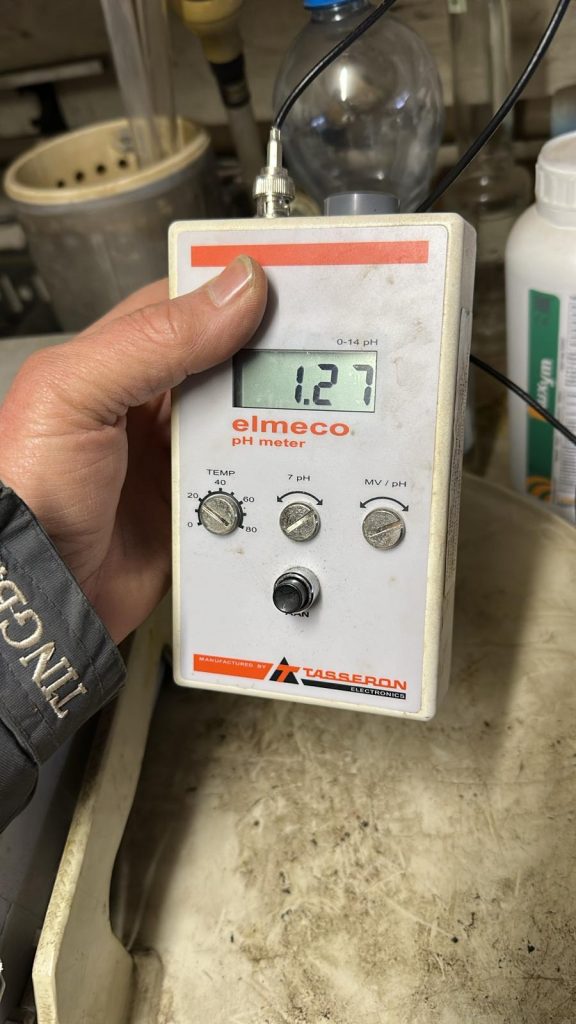
The last year and this spring again an increasing number of crops where the iron is available in the irrigation water, in high enough concentrations. The recipe is good, but still a lack of iron, because of the pH of the tank where the iron is in (normally the A tank).
The big issue is that iron oxidises very easy which makes it not available for plant uptake. Because of this oxidation of iron we use chelates (an organic molecule) to keep iron plant available. The issue with the chelates is, that if the pH in the tank is too low, the chelates brake down and the iron is not plant available any more.
Therefore, don’t put your acid in the A tank or in the tank where you put your Ironchelates also. The optimum pH for the chelates are depending on the type of chelates you have. This information is normally available on the packaging.
Below you see some pictures of strawberries with an excellent recipe, but where the pH in the A tank dropped a bit too much as you can see on the picture above.
In the past i have written more about irrigation. Most growers experience it as one of the hardest subjects of growing strawberries. There are so many links to the growth: – Vegetative / Generative growth balance – Rooting – Quality of the strawberries (tast, firmness, skin quality and sensitivity) – Production
But it also direct connects to EC / Feed, Diseases (leaf and root diseases), Tipburn.
Every reason to just do it good, if possible at all.
A few basics of irrigation: – direct relation between evaporation and radiation (more radiation = more uptake) – there is no irrigation system 100% perfect, therefore we need drain to compensate those mistakes – drain is also needed to flush balast salts or too high EC
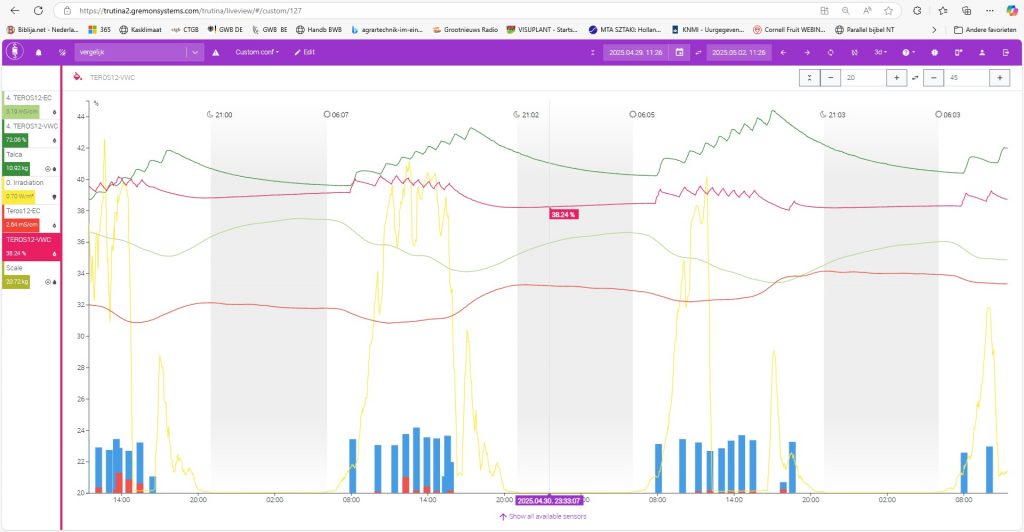
Above you see different irrigation graphs. Green: dark green – moisture content grower 1 ligh green – EC grower 1 Reddish: purple – moisture content grower 2 light green – EC grower 2 Yellow: radiation (Watt/m2) Bar graph: blue: irrigation amount red: drain water In green a nice irrigation: moisture content is increasing over de day and decreasing in night time. The green line below it is the EC, which is stable or a bit decreasing. Irrigation from the other grower is in red/purple. There you can see a quite stable or even slightly decreasing moisture content. This in combination with the EC increasing. In the bar graph below blue = the irrigation, red is the drain. It is clearly visible that there is only just a bit of drain, not enough to even out mistakes or flush high feed contents.
Normal drain percentages for full grown crops: – Sunny weather: 30-40% – Half cloudy: 15-25% – Cloudy, rainy: 5-15% Normal dry – down: – between sunrise and first irrigation: 0,5-1,5% – between last irrigation and sunset: 1-2% – between last irrigation and the first irrigation next morning: 3-6% – lower dry downs is more vegetative growing, higher dry downs is more generative growing. Rooting paterns are direct influenced by the way you irrigate:
– dry growing: roots mainly in the lower 25% of the substrate – wet growing: roots higher in the substrate and less in the bottom 10% of the substrate – good growing: roots everywhere but in the top 2 cm of the substrate – irregular irrigation: white and brown roots
On the left side dry growing: roots on the bottom and not enough roots in the rest of the substrate
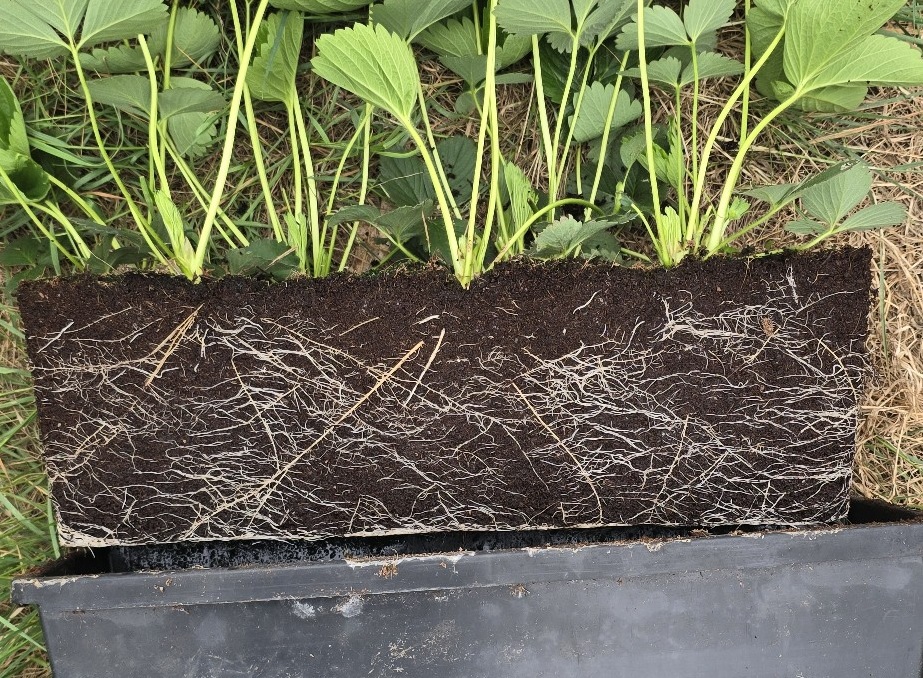
Good rooting strawberries: almost everywhere
In order to know if you are on track, drain% are one of the ways to check it, as mentioned above. The other things that is really important is that the irrigation is stable. Therefore we have a check mechanism: ml/joule (or officially: ml/m2 / joule/cm). This should be quite stable: – between the irrigations of the day – stable between the days. It should also be almost the same on a dark cloudy day as on a bright sunny day.
If you take care of this irrigation being stable, and the drain percentages are correct, you normally have a good rooting crop, like you can see in the picture above. The best way to get this stable is by using the irrigation based on radsum, and not or almost not limited by time (min time or max time). Most growers i visit i advice to set the max time on about 6 hours and the min time on about 10-15 minutes.
Strawberry quality issues are mainly the consequence of irrigation, high EC or recipe.
Irrigation: – big deviations in ml/joule within the day or between the days, causing roots sometimes to be dry, sometimes to be water soaked. – too much irrigation in warm, very humid days or evenings may cause root pressure issues: fruits getting soft because they collapse.
High EC: – too high EC gives a hard water uptake and a bad uptake of for example calcium causing softer fruits
Recipe: – high ammonium, too high or too low potassium may cause soft fruits. – therefore take frequent drain and irrigation water samples and have them analized.
Production
There is a direct correlation between water uptake and production. If the water uptake of a crop slows down, production (total production = leafs, flowers, strawberries, roots) drops. We need al these in order to get a good fruit production. You want your water uptake to be paralel to the radiation (watt/m2). If that is correct, irrigation seems to be good. If the water uptake is influenced by your irrigation (increase in water uptake right after an irrigation), the water uptake and evaporation was limited by the water content in the substrate – thus limiting production and/or quality.
The virgin gives birth God is condemned Man raised from the death – eastern –
For Christians the most important feast: God loves us people so much, that for us He lived on the earth, for us He suffered. So we may gain new life. Therefore for me the new spring, new flowers, new strawberry plants growing, is every year a sign of this new life.